85 Problems with AI Recruitment today: A Principal Recruiter's Reality Check of Josh Bersin's AI Revolution
Andrea Lungulescu is back at it again with this incredible post. (original post)
In his recent podcast "How AI Will Revolutionise the HR Department, in Detail" Josh Bersin presented an ambitious vision of an AI-driven end to end talent (process) approach. I am a huge fan of Josh Bersin’s work, it's only that this podcast episode prompted me to pigeonhole it.
All while knowing that he solely presents a “what could be” scenario.
As a Principal Talent Partner, I analysed this vision considering Pedro Porto Alegre's insight that "problem-finders are just as valuable as problem-solvers".
And I found 85 problems.
This is a very deep journey into:
My perspective will also be particularly relevant when examining the implications of AI in Recruitment.
The Context of Problem Finding
Before diving into Bersin's vision, I want to acknowledge Pedros's fundamental point: identifying potential issues early is crucial for any (technological) transformation. In Talent Acquisition, this means scrutinising proposed solutions before implementation, not after they've become costly mistakes.
Deep Dive
Until “what could be” turns to life (something tells me we still have a bit to go, by all accounts) I will present my review in a table format. Below each Table will be some additional ideas of mine on what can be done (on top of, obviously, solving the problems).
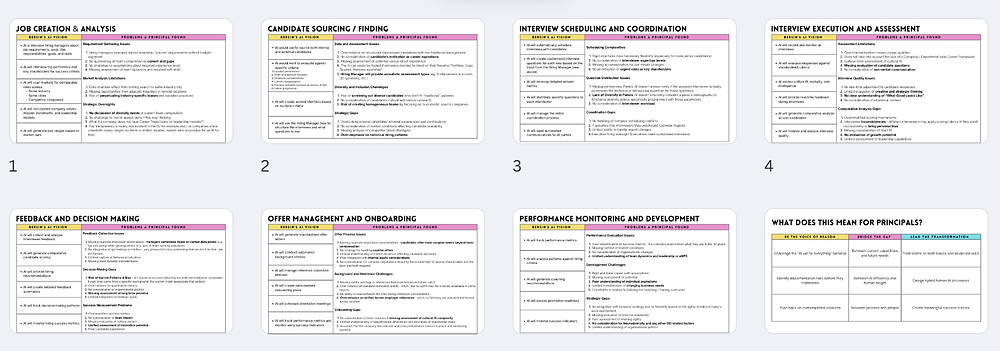
Each Table is Expandable and can be Downloaded.
How to read this:
Column A - Bersin’s AI Vision - I extracted the information from the Podcast.
Column B - Problems a Principal Found - where I see the gaps in that approach. These are also things you should DO in your role (anyway).
Text Below - A Principal's Practical Approach - Here are additional things I would do as a seasoned Talent Acquisition professional.
NOTE: AI is not to be excluded, quite the opposite.
I solely make the case that some teams are so far behind, that no AI will truly be their saving grace. So let’s get the “basics” right, shall we?
Pre-Recruitment Process
Job Creation and Job Analysis
Overview: Job creation and analysis encompasses stakeholder requirements gathering, market analysis, and compensation planning. Bersin proposes AI systems to conduct interviews, analyse market data, and generate job specifications.
Challenges: Companies often lack structured data and frameworks for requirements, career paths, and compensation. Regional differences in pay transparency and inconsistent market data create additional complexity. Many organisations struggle with unrealistic role requirements and limited market perspectives.
Solutions: A combined AI-human approach strengthens the foundation of job creation. AI processes market data while recruiters validate requirements, expand market analysis, and integrate strategic priorities. This requires clear frameworks for job analysis, market benchmarking, and succession planning.
A Principal's Practical Approach
Candidate Sourcing / Finding
Overview: Candidate sourcing involves evaluating internal and external talent against location, compensation, and career progression criteria. Bersin suggests AI systems can create scored shortlists and structure interview approaches.
Challenges: Current AI systems cannot effectively assess non-traditional backgrounds or candidate potential. They miss crucial elements like motivation and cultural contribution, while often reinforcing existing hiring patterns.
Solutions: Combining AI data processing with human insight allows for comprehensive candidate evaluation. This requires clear frameworks for assessing potential, implementing inclusive sourcing strategies, and developing market intelligence systems
A Principal's Practical Approach
Recruitment Process
Interview Scheduling and Coordination
Overview: Interview coordination encompasses scheduling, question distribution, and stakeholder communication. Bersin proposes AI systems to manage the entire process automatically.
Challenges: Complex scheduling requirements and interviewer expertise matching often require flexibility and human judgment. Standard AI systems struggle with last-minute changes and panel composition needs.
Solutions: A hybrid system combines AI's scheduling efficiency with strategic panel design and expertise matching. This includes maintaining interviewer capability indices and implementing priority-based scheduling protocols.
A Principal's Practical Approach
Interview Execution and Assessment
Overview: Interview assessment involves evaluating responses, cultural fit, and candidate potential. Bersin suggests AI can monitor interviews and provide real-time feedback against standardised rubrics.
Challenges: Standardised assessments often miss unique qualities and non-verbal cues. AI systems struggle with contextual understanding and creative thinking evaluation.
Solutions: Structured evaluation frameworks combine AI-generated insights with human observation of subtle indicators. This includes comprehensive assessment tools and advanced interviewer training.
A Principal's Practical Approach
Feedback and Decision Making
Overview: The feedback process includes collecting interviewer input and generating hiring recommendations. Bersin proposes AI systems to analyse feedback and track decision patterns.
Challenges: AI struggles with nuanced observations and organisational context. Many systems oversimplify complex hiring decisions and team dynamics.
Solutions: Balanced decision frameworks integrate AI's data analysis with human insight into team fit and potential. This includes clear feedback structures and bias mitigation protocols.
A Principal's Practical Approach
Post-Recruitment Process
Offer Management and Onboarding
Overview: Offer management involves compensation negotiation and integration planning. Bersin suggests AI can generate offers and create personalised onboarding plans.
Challenges: Complex negotiations and cultural integration require nuanced human interaction. Regional differences and organisational politics impact success.
Solutions: Strategic offer management combines AI's process efficiency with human-led negotiation and integration planning. This includes comprehensive onboarding frameworks and success metrics.
A Principal's Practical Approach
Performance Monitoring and Development
Overview: Performance tracking involves measuring success indicators and development potential. Bersin proposes AI systems to monitor metrics and generate coaching recommendations.
Challenges: Success metrics often lack organizational context and individual circumstances. Many systems struggle with informal leadership and learning agility assessment.
Solutions: Holistic performance frameworks combine AI-driven metrics with human evaluation of potential and team impact. This includes flexible career pathways and comprehensive development tools.
A Principal's Practical Approach
The Reality Check: Where Do We Go From Here with AI Recruitment?
Jan Tegze wrote about the evolution of the recruiting landscape in 2025. And he talks about lean recruitment teams, AI investments, and the rise of the full-stack recruiter (strategic thinking, stakeholder management, balancing AI efficiency with human touch, etc.).
Yes on all his points. And, I believe we need to go further.
Why? Because We-Are-Still-Missing-The-Point.
The recruitment industry has a habit of jumping on bandwagons.
But here's what we're not talking about enough
Teams aren't ready - most recruitment teams still struggle with basics like:
The infrastructure isn't there - we're talking about AI making complex decisions when many organisations:
The human element is undervalued - we keep forgetting that recruitment is fundamentally about:
Proper "intake" processes
Don't have clean data
Understanding nuanced team dynamics
Structured interview frameworks
Lack integrated (HR) systems
Reading between the lines in interviews
Clear feedback mechanisms
Haven't sorted out basic privacy compliance and Governance
Navigating organisational politics
Data-driven decision making
Can't measure current ROI effectively
Building genuine relationships
What Does This Mean for Principals?
This is where Pedro's insight about problem-finding becomes essential. We need to:
The Path Forward
Here's what needs to happen:
In Conclusion
Bersin's vision is compelling, and Tegze's review is great. And recently I listened to a Podcast episode from Matt Alder as well, where he speaks to another industry leading voice - John Vlastelica, about how TA leaders and recruiters can navigate this transformation, address challenges like bias, etc.
But…finding the problems is just as important as solving them. So, I found them.
I think I could also solve them.
Not alone.
With other humans.
And with AI.
The future of talent acquisition is really not about AI replacing humans or humans fighting AI.
It will be about us being better in our roles by being AI enabled.
It will be about thoughtful transformations and a balance between tech and human.
Can any and all Recruiter roles withstand this shift?
I sadly doubt it.
I do believe though, that someone who is able to manage operational recruitment responsibilities, act as a multiplier, mentor and coach, manage large projects, influence at scale, lead change and design and implement innovative solutions and processes - all by utilising / weaving in AI capabilities - will very much succeed.
I told you I love my job!
Andreea
This is very well aligned to Sonita’s “What to build: an Outhouse or Gazebo?” LinkedIn Post. Build-the-outhouse!