Career Journeys in Talent Acquisition: Kye Lovelace
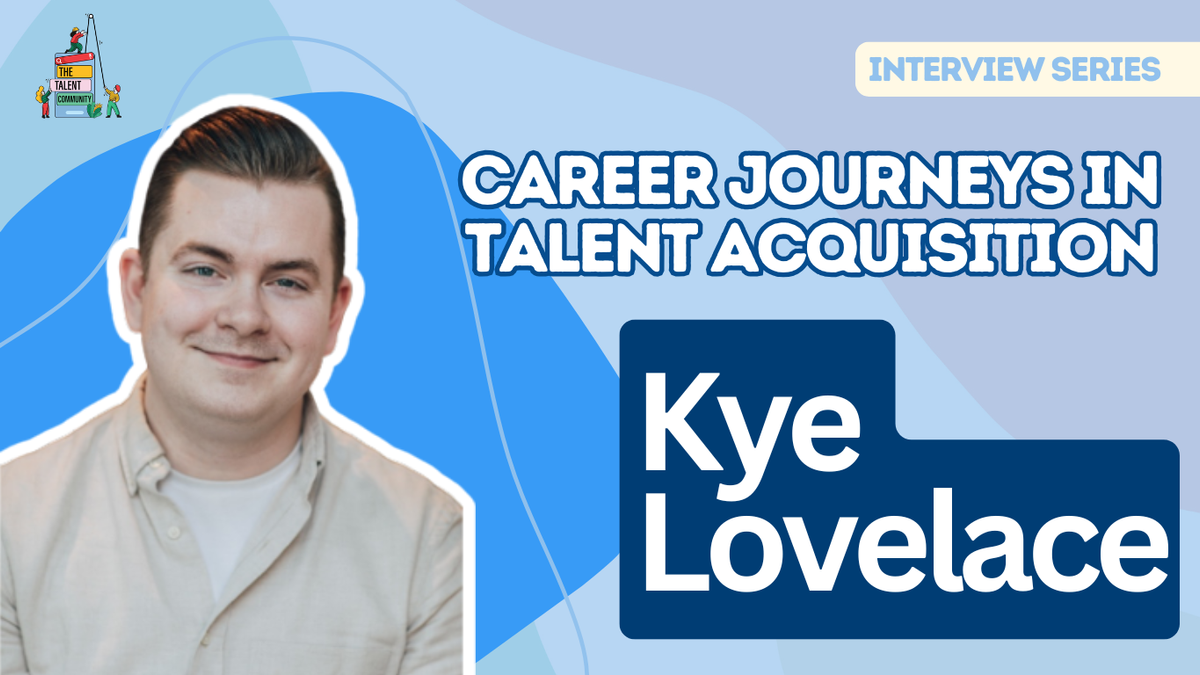
Thanks for reading! This series is designed to shine a spotlight on Talent Acquisition professionals and highlight their career journeys and learnings so far. Today, we're joined by Kye Lovelace. If you'd like to be next, please reach out to a TTC Community Manager.
Introduce yourself in one sentence:
Kye Lovelace is a Talent Acquisition leader and founder of Velo North who builds in-house hiring functions and the AI tooling behind them across hospitality, tech and startups, is currently open to new opportunities, he also occasionally moonlights as a DJ on the side through his events business DFRACTD Events. Connect with him here.
Can you walk us through the key milestones in your career in the talent acquisition space? What were some pivotal moments or decisions that shaped your journey?
My journey into talent acquisition really starts long before my first recruitment role, because I didn't come up through a world that was built for someone like me. I'm neurodiverse and part of the LGBTQ+ community, and navigating an education system and a working world that weren't designed with people like me in mind meant the expectations placed on me early on were low. I was, in not so many words, not really expected to achieve much.
When I was younger I struggled a lot with anxiety and with what other people thought of me. But as I grew through my career, something shifted, the more I built and the more I proved to myself, the more confidence I found to simply own who I am. My mum was my constant champion through all of it, believing in me relentlessly even when the systems around me didn't, and a lot of what I've built since is down to that belief. Beating those low expectations gave me a lens I've carried into every role since: an instinct for the people who get overlooked, and a conviction that talent shows up in places the traditional process misses.
That's why talent acquisition felt like the right home for me. I started out in frontline retail, managing teams and discovering I loved the hiring side most of all, and moved into TA properly at GetAgent, a proptech scale-up, before joining KERB, the hospitality and events group, as the first person in recruitment. Building that whole function from scratch, the systems, the processes, the strategy, across multiple sites and countries, taught me more than any established function ever could. It also gave me the autonomy to bring my values into real decisions: when I reviewed our preferred supplier list, I deliberately shifted us towards independent, boutique agencies aligned to the business's values, rather than defaulting to the biggest names. Most recently, at Borderless, a VC-backed tech startup, I helped build an AI-native talent function from the ground up, and that's where my real edge came into its own: building my own AI-powered tooling to make hiring faster, fairer and more human. I'm not an engineer by training, but AI closed that gap, and it's now central to how I work.
That growing confidence also gave me a reason to speak up, and I've tried to put that into practice rather than just talk about it. Within my roles I've done that in practical ways, sitting on KERB's internal Pride committee, and working with Pride in London as a Talent Partner alongside their Head of TA at the time, Mark Jenkins, and the team to help transform their hiring function. More recently I joined the Better Hiring Institute and contributed to discussions on worklessness and building genuinely accessible workplaces, work that took me all the way to contributing to a discussion in Parliament on the subject. For someone once expected to achieve very little, standing in that room and being heard on making work more accessible meant a great deal. Because representation and access genuinely matter, and I know first-hand what it's like to be on the outside of a system that wasn't built for you.
Looking back, I'm proud of how far I've come from where I was expected to end up, a career I care about, a network of people I respect and learn from, and the confidence to be fully myself. But I try to hold that lightly. What's driven me from the start isn't arriving somewhere; it's the building, the learning, the growing, the next problem to solve. I'm currently exploring my next opportunity, as motivated as I've ever been to keep building, keep learning, and hopefully help others who were counted out realise they shouldn't be.
In this rapidly evolving industry, what strategies or practices have you adopted to continuously enhance your skills and stay ahead of the curve? Do you have any resources or learning methods you'd recommend to others?
Honestly, my main strategy is to learn by building. I've never been someone who can absorb a new tool or idea in the abstract, it only sticks when I actually use it to solve a real problem. So when something new emerges in hiring tech or AI, my instinct isn't to read about it and file it away, it's to get hands-on and build something with it, even if it's rough. That's how I taught myself to create my own recruiting tooling with AI, sourcing workflows, analytics dashboards, automations, despite not being an engineer by background. The building is the learning.
Practically, that means I keep a live 'sandbox' mentality. I'll take a repetitive part of my week and ask whether AI or automation could do it better, then actually try. Half the time it doesn't work, but I learn something every time, and the things that do work compound. Staying current, for me, is less about consuming information and more about constantly experimenting.
Alongside that, I stay close to the community, because the fastest way to know what's genuinely working (versus what's hype) is talking to other practitioners who are trying the same things. That's a big part of why I'm involved with groups across the TA space, being in rooms with people solving the same problems is worth more than any single course.
If I had to recommend a few things to others: first, pick one tool and go deep rather than dabbling in ten, depth beats breadth. Second, follow practitioners, not just platforms, the people actually doing the work share more useful signal than vendor marketing. Third, find yourself a mentor from outside your own organisation, someone with no stake in your internal politics who'll give you honest perspective and challenge your thinking is worth more than you'd expect, and it's something I wish I'd done sooner. And finally, build something, however small. You learn more from a scrappy automation you made yourself than from ten articles about what's possible. The industry moves fast, but the people who stay ahead are usually the ones who tinker, not just the ones who read.
What has been the most challenging aspect of your career in talent acquisition, especially when you were actively seeking work? How did you overcome it, and what advice would you offer to others facing similar hurdles?
The most consistent challenge in my career has been not fitting the box people expected me to fit, and learning to back myself anyway rather than apologise for it.
That started early. I came into the working world from a background the traditional route wasn't really built for, and I didn't fit the conventional academic mould, I couldn't tell you much about pi or how to find a square root, and educational institutions had a way of making that feel like a failing. But even then, I knew I had a different kind of strength: give me a genuinely complex problem and I'll come back with a well-structured solution. Problem-solving was the thing I was quietly, unusually good at, long before I had a job title that valued it.
It took me a while to trust that, though. As my career developed, that same tension showed up in a new form, I'm a builder and a generalist, I build functions from scratch, I build tooling, and that breadth doesn't always map neatly onto a job description looking for a narrow specialist. Early on I'd try to shrink myself to fit, downplaying the breadth rather than leading with it.
What changed things was getting real evidence that the way I think is a strength, not a quirk. An Insights Discovery profile came back predominantly red and blue, which mapped almost exactly onto how I approach problems: challenge the status quo, think creatively, and drive to a clear resolution quickly. Over the years I've had consistent feedback from managers about how fast I resolve things, particularly deep, technical problems that can otherwise stall a team. And when I did my Level 7 in TA Strategy, I finally had the language for why this matters: cognitive diversity, having genuinely different ways of thinking in a team, is one of the biggest drivers of good decisions and outcomes. The thing that made me feel like an outsider was, it turned out, exactly the thing teams need more of.
That reframed everything. The moment I stopped apologising for not fitting the mould and started leading with what made me different, the problem-solving, the function-building, the AI tooling, everything got easier. The right people and businesses were the ones who wanted exactly that.
I won't pretend that challenge has fully disappeared, being between roles right now, you feel the same pull to shrink yourself to fit a brief. But I've learned to resist it. So my advice to anyone facing something similar: don't file the edges off yourself to fit a box that was never the right fit anyway. Get clear on what genuinely makes you valuable, especially if it's unconventional, find the evidence that backs it up, and lead with it unapologetically. The right opportunity wants you for your actual strengths, not a watered-down version of them.
The recruiting world can be fast-paced and demanding. How do you strike a balance between your professional commitments and personal life? Are there specific routines or rituals you follow?
I'll be honest, I've never been someone who draws a hard line between 'work' and 'life,' and part of that is just how my brain works. I have ADHD, and switching off doesn't come naturally, I've usually got a million ideas I want to chase, and I genuinely find comfort in tinkering with some of them. For a long time I saw that as a problem. Now I see it as something to work with rather than against.
The thing that makes it sustainable is time segmentation. Rather than fighting the fact that my mind is always running, I give different things their own space, dedicated time to experiment and build, and, just as importantly, protected time that's completely off. That structure is what stops 'always having ideas' from tipping into 'never switching off.'
The other half of it, and I can't stress this enough, is genuinely practising good mental hygiene. It's easy, especially with a brain like mine, to just keep going. So I'm deliberate about the basics: taking actual holidays, building in rest and breaks, going to the gym, meditating. The unglamorous stuff that's the first to get sacrificed when you're busy and the last thing you should cut. Reserving time purely for yourself isn't indulgent, it's what makes everything else possible.
I also make sure I have a creative outlet that's completely separate from recruitment, I DJ, and run a small events business called DFRACTD on the side. When I'm behind the decks I'm fully present in something creative and physical, using a totally different part of my brain, and it's one of the best resets I have.
I won't pretend I've got it perfectly figured out. But the honest version of balance, for me, isn't a rigid nine-to-five with a clean off-switch, that was never going to be my reality. It's channelling the way I'm wired into the right structure, and being disciplined about rest so I actually stay well. When I get that mix right, I feel like myself, and I do my best work.
As someone involved in talent acquisition, you've likely witnessed various technology and trend shifts. Which technologies or trends do you believe have had the most significant impact on the industry, and how have they influenced your role?
The obvious answer is AI, and it genuinely is the biggest shift I've seen, but I'd frame its impact slightly differently to how it's usually talked about. The headline take is that AI helps you source faster or screen more efficiently, and that's true. But the change that's affected me most is more fundamental: AI has collapsed the gap between having an idea and being able to build it. For most of the industry's history, if you wanted a custom tool or workflow, you needed engineering resource and a budget. Now a single practitioner can build their own tooling, sourcing workflows, analytics dashboards, automations, in an afternoon. That's genuinely changed what one person in a talent function can do, and it's changed my role completely.
For me personally, it meant I stopped waiting for tools to be handed to me and started building them myself, despite not being an engineer. That shifted me from being a user of recruitment technology to someone who shapes it around exactly how I want to work. I think that's the real revolution, not AI replacing recruiters, but AI dramatically expanding what an individual recruiter is capable of building and automating.
That said, I try to hold a healthy scepticism alongside the enthusiasm, because there's a lot of hype in this space, and not all of it survives contact with reality. Plenty of 'AI-powered' hiring tools are thin wrappers that add little, and some genuinely risk baking bias into the process or stripping out the human judgement that good hiring depends on. So the trend I actually care about isn't 'more AI', it's thoughtful AI, using it to remove the repetitive, low-value work so that people have more time for the parts of hiring that genuinely need a human: judgement, relationships, candidate experience.
If I had to name a second shift, it's the move towards treating hiring as a data-informed function rather than a gut-feel one, better analytics on what's actually working across the funnel. Used well, that's made hiring more rigorous and fairer. The two trends reinforce each other: AI and automation generate the capability, and good data tells you whether it's actually improving outcomes or just making you feel busy.
Ultimately, the technology I'm most interested in is whatever lets hiring be both faster and more human at the same time. For a long time those felt like a trade-off. The best of what's emerging is starting to prove they don't have to be.
For those entering the talent acquisition space or those looking to pivot within it, what's the one piece of practical advice you'd give to help them thrive, especially if they are actively job-seeking?
My one piece of advice: don't aim for where talent acquisition is now, aim for where it's going.